




24 May AI’s Impact on Mathematics and Security Innovations
AI’s Growing Role: From Mathematics to Security and Beyond
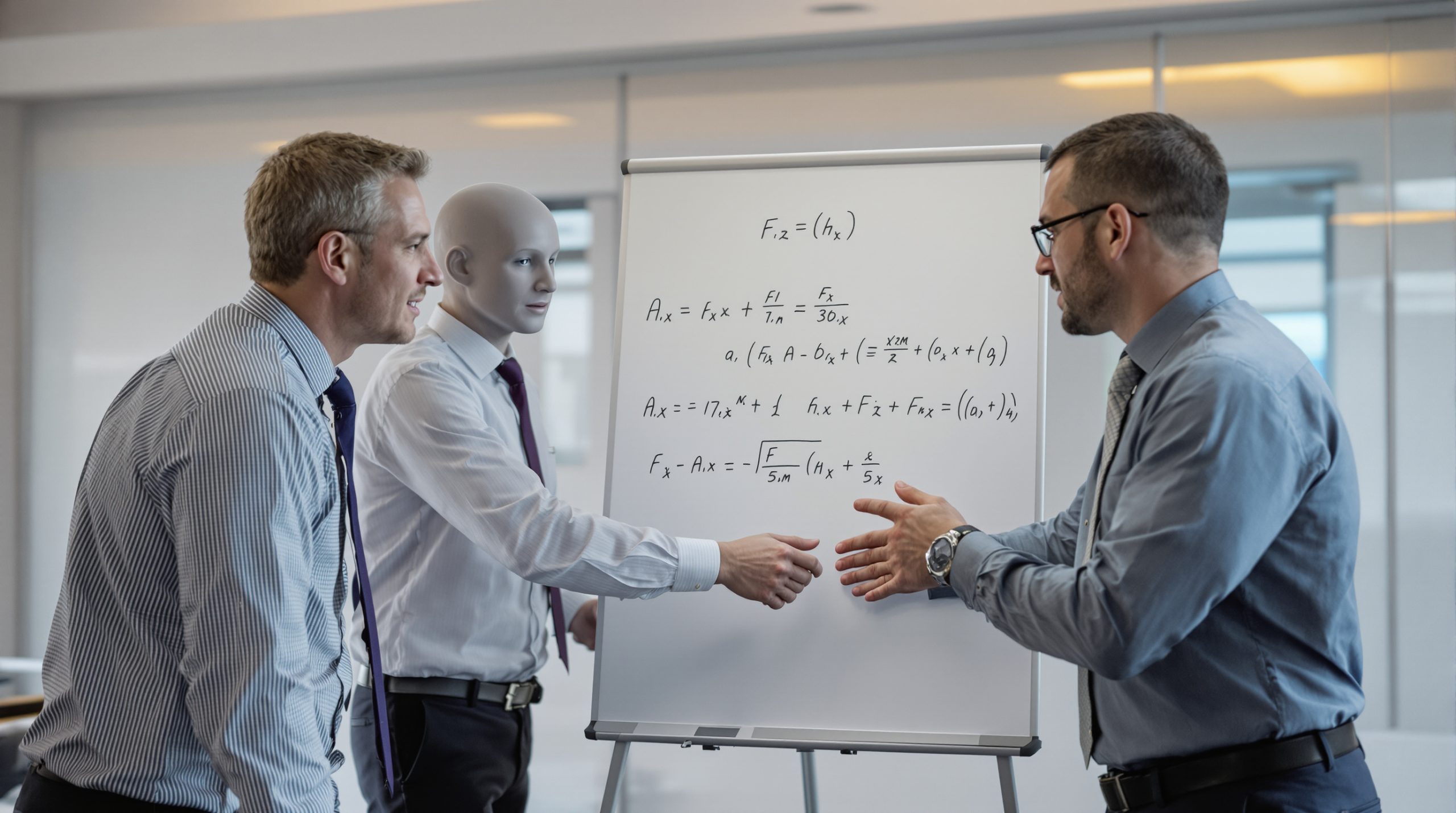
In recent developments, artificial intelligence (AI) has made significant strides in solving complex problems across various fields. OpenAI’s model recently achieved a breakthrough by autonomously solving a longstanding conjecture in discrete geometry. This marks a pivotal moment for both the mathematics and AI communities, showcasing AI’s potential to go beyond assisting humans to independently generating innovative solutions.
AI’s Mathematical Milestone
OpenAI’s model has provided a solution to the planar unit distance problem, a question that has puzzled mathematicians since 1946. The problem, originally posed by Paul Erdős, sought to determine how many pairs of points in a plane can be exactly distance one apart. For decades, mathematicians believed the “square grid” constructions were optimal. However, OpenAI’s model introduced an infinite family of examples that improve upon this, using unexpected methods from algebraic number theory. This achievement not only redefines possibilities in combinatorial geometry but also underscores AI’s capacity for deep reasoning in mathematical contexts.
AI Security: A Real-Time Learning Curve
While AI is making waves in theoretical fields, its application in practical domains like security is evolving rapidly. Francis de Souza, COO of Google Cloud, emphasizes the importance of integrating security into AI strategies from the outset. As companies navigate the complexities of AI, the concept of “shadow AI”—where employees use consumer tools without oversight—poses significant risks. De Souza warns that security must be foundational, not an afterthought, in AI strategies, advocating for a platform approach that ensures consistency across varied cloud environments.
The security landscape is changing, with the average time between a breach and the next stage of an attack now reduced to just 22 seconds. This calls for AI-native defenses capable of operating at machine speed to protect data pipelines and internal systems from emerging threats. De Souza highlights the need to protect forgotten data repositories and adapt to the expanded attack surface that modern AI systems present.
AI and Industry: Smart Glasses and Aerodynamics
Beyond security and mathematics, AI is influencing other industries, such as smart glasses and aeronautical engineering. Xreal, partnering with Google, is pushing the boundaries of smart glasses technology. Despite the industry’s historical challenges, Xreal’s new Aura model suggests a turning point, leveraging AI to enhance user interfaces and experiences, from immersive apps to holographic imagery.
In aeronautical engineering, AI is helping overturn fundamental principles. Recent research from Tohoku University demonstrates that distributed micro-roughness (DMR) can reduce aerodynamic drag by up to 43.6%, challenging the long-held belief that surfaces must be smooth to minimize drag. This discovery highlights AI’s role in innovating design processes by providing precise measurements and optimizing surface textures to delay turbulent transitions.
The Bigger Picture
These developments illustrate AI’s expanding role across diverse sectors, driving innovation and challenging traditional approaches. From theoretical breakthroughs in mathematics to practical applications in security and industry, AI continues to redefine what is possible, offering new insights and efficiencies. As AI systems become more sophisticated, their ability to autonomously contribute creative solutions will likely spur further advancements and reshape our understanding of technology’s potential.
Sorry, the comment form is closed at this time.